More about Whales
/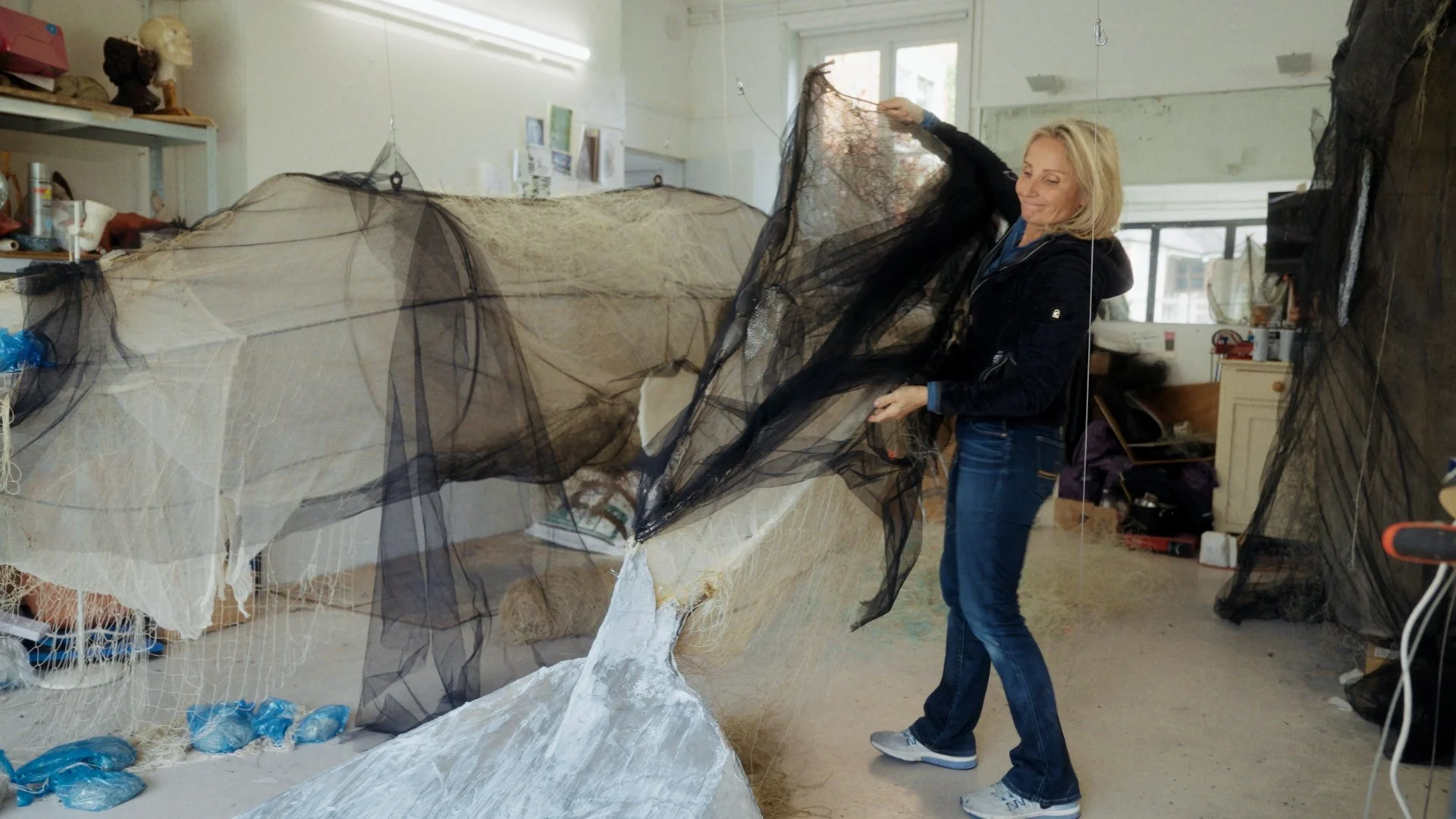
Campbell Fraser’s life has always been immersed in and informed by animals, so that she sees little distinction between the human and animal worlds. In her art, her engagement with animals has been total, spending hour upon hour sitting peaceably with her animal subjects, trying to understand them and longing for a total communication. Her concern at man’s incursions into, and disruptions of, fragile ecosystems has led her into a challenging engagement with herself as human and animal.
In this exhibition, Campbell Fraser will seek to unravel the interspecies communications between man and animal that are currently at the forefront of scientific research. She will create three monumental (5.2m, 4.6m and 3m respectively) sculptures of sperm whales which will hang from the roof of the tithe barn. The open timbers and roofbeams of the barn are reminiscent of an upturned boat, carrying subliminal associations with the industrial scale whaling which reduced sperm whale numbers to critical levels in the 19th century, when their waxy spermaceti oil famously oiled the wheels of the Industrial Revolution. The sculptures offer a response to the environment whereby the viewer becomes immersed into an imaginative world of the whale whilst the surroundings reflect man’s increasing ecological impact on the world’s climate.
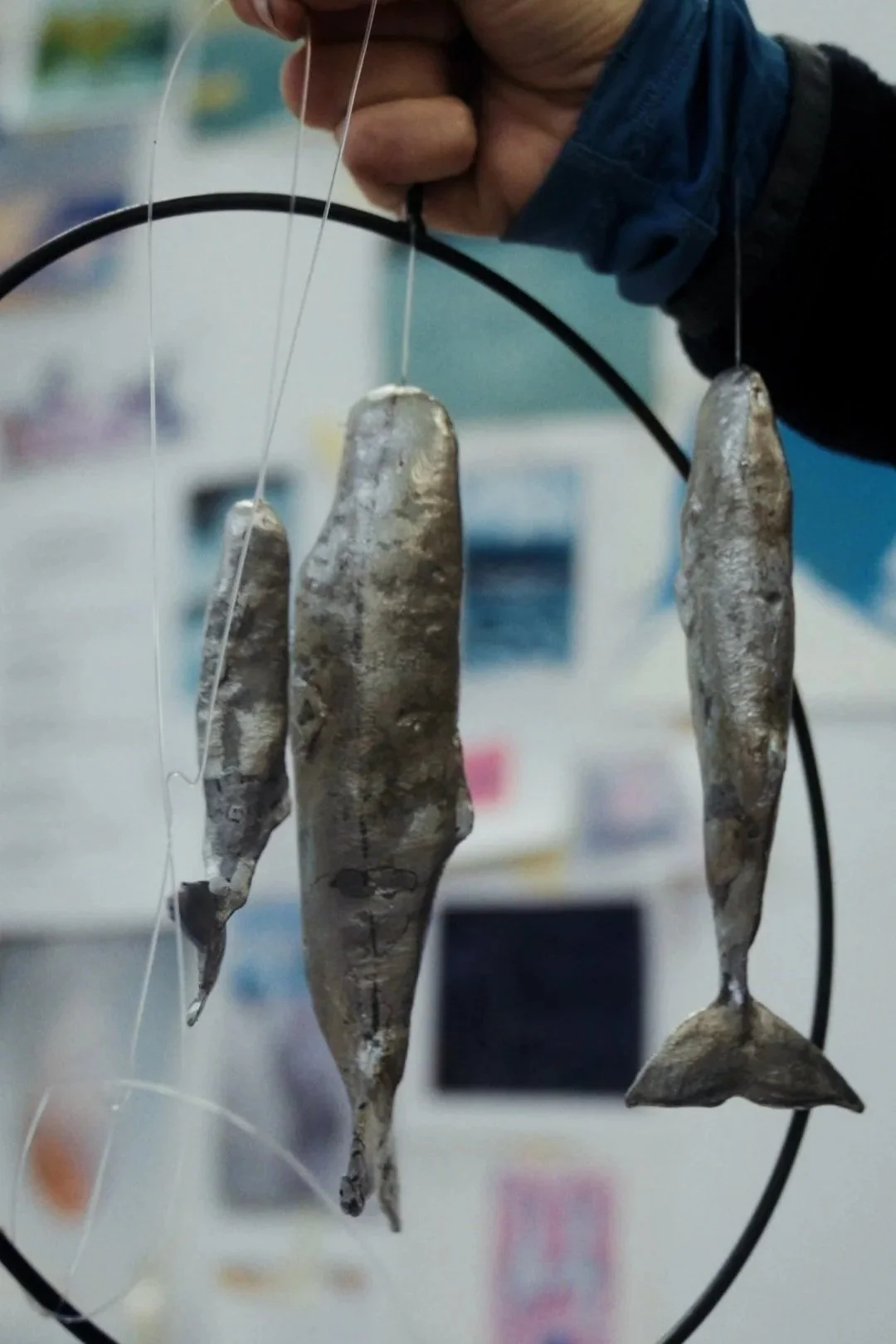
Always fascinated by the physicality of substance, texture, form and space (both positive and negative), Campbell Fraser deliberately seeks out and employs sustainable, natural, recycled or repurposed materials. In this exhibition she is using recycled ghost netting, silk chiffon, latex, and synthetic (recycled) paper, made with almost no water. Using haptic techniques with these materials, she creates fluid, protean pieces in two-and three-dimensional forms to explain her dialogue between herself and nature.
Campbell Fraser’s work embraces and reinvigorates the Romantic concept of the Sublime, the belief that, ‘every Person upon seeing a grand object is affected with something which as it were extends his very being and expands it to a kind of Immensity’[1]. In her art she interconnects and delves into the idea of the ‘breath’ of natural phenomena, which links to the breath of every living creature and to the Gaia Hypothesis[2] She will explore her relationship with ‘remote’, ineffable land- and seascapes, which evoke ‘something greater than ourselves’[3] – the ‘sense sublime of something far more deeply interfused’[4]
Campbell Fraser has immersed herself in an in-depth exploration of sperm whales, considering their complex social lives, their expressions of love, suffering and compassion. These mammals, with the largest brains on the planet and living, like humans, in tightly knit family groups, are often seen as the most likely animals with which man can have an inter-species communication.
Through research into Project Ceti, Campbell Fraser has incorporated the science of communication into her art. This has invigorated her creative response to her subject and her yearning for interconnection. Over five years, this science-based experiment in Dominica has gathered vast amounts of Sperm Whale data, using underwear hydrophones to capture and record their distinctive ‘coda-clicks’. Along with studying their behaviour and methodologies to interpret the whales’ sounds. They have already discovered that whales have varying dialects and twenty-three different patterns of ‘coda-clicks’. AI has already been used to translate two unknown human languages without the need of a ‘Rosetta Stone’. Scientists are hopeful that it may be able to do the same with whale coda.
Campbell Fraser’s exhibition will seek to weave both artistic and scientific strands to convey the mystery of the sperm whale, a creature that seems tantalisingly intelligible and yet remains so alien to us. She has always sensed that she cannot sculpt what she cannot see or feel, as she needs to be “present and listening” to “reveal what is beautiful, and the potential in nature for us to learn from”. She has just returned from Dominica, where she swam with her beloved sperm whales and experienced an intense interaction with them: “I didn’t quite know what to expect being face-to-face with these giant creatures in their environment. I hoped I would hear them coda click, and indeed I did, but it wasn’t these sounds that gave me the intense feeling of an inter-species communication, it was more the fact that I was one female in a group of other females and I felt part of their clan. I had no sensation that I didn’t belong in the underwater world or that we were alien to each other or that I was in any way in danger. It was almost as if we’d come from the same beginnings. Perhaps we have; after all they have finger like digits in the pectoral fin, left over from 15 million years ago when they were walking land animals with a skin-like texture on their bodies.”
“In sculpting the whales as I have- transparently, using ghost netting- I want to convey the need for mankind to realise that these great beasts will not be around in our world if we don’t act now to prevent catastrophic global warming. Rising sea temperatures will disrupt the entire ecological balance, causing these sea creatures to become mere ghosts to us, transparent in the extreme. And yet even within the whale’s story we can learn from nature. When a whale dies, its carcass, which has accumulated carbon during its long life, sinks to the bottom of the ocean, locking away 33 tons of co2”
Campbell Fraser is fascinated by this exploration of interspecies communication through decoding, but found her own immersive experience with the whales profoundly inspiring: “Really, what I experienced in those moments was a far more knowing conversation about myself, my personal views of being a woman today- perhaps I was connecting, like the Inuit people do, on a deeper and more spiritual level, with these magnificent mammals. I certainly surfaced from the water with a clear message from our encounter that to exist in this world, peacefully and fulfilled I would do well to listen to this ancient tongue with its truly primeval message. A romantic I may be, but it certainly made me realise this world is uniquely special and worth saving.”
Campbell Fraser’s personal encounter with the whales does not take away from her excitement at the possibilities of science decoding or “the enormity of the breakthrough to mankind if we really can have an interspecies conversation - it could reshape how we coexist with nature.” In an artistic response to the science, Campbell Fraser has devised her own form of a Victorian Eidophone, using the vibrations of whales’ coda clicks to make her own visual interpretations of their conversations. These visceral responses float across and through transparent paper, echoed by mirrors suspended in space like an evocation of a fleeting spoken conversation. In another collaboration with a music technician, she also attempts to have her own- and the viewer’s- version of a conversation with the whales.
Through this immersion with her subject, Campbell Fraser has come to appreciate her own creative journey. Like many, she has often felt overwhelmed and moved to despair by the immensity of the crisis facing the world, but has discovered a poignant beauty in her own attempt to find answers. She went underwater to hear the whales and experienced a heartfelt, immense peace and connectedness in her realisation that she was a female floating amongst a pod of female whales. She experienced communication of a different kind as all her thoughts and motivations fell away, to be replaced by an immense stillness, gratitude and sense of humility in the company and grace of these magnificent slow-moving creatures.
[1] John Baillie, An Essay on the Sublime, 1747
[2] The Gaia hypothesis, formulated by John Lovelock, proposes that ‘living organisms interact with their inorganic surroundings to form a synergistic and self-regulating, complex system that helps to maintain and perpetuate the conditions for life on the planet’
[3] Iain McGilchrist, The Master and his Emissary, 2010, p.363
[4] William Wordsworth, Tintern Abbey, July 1798